
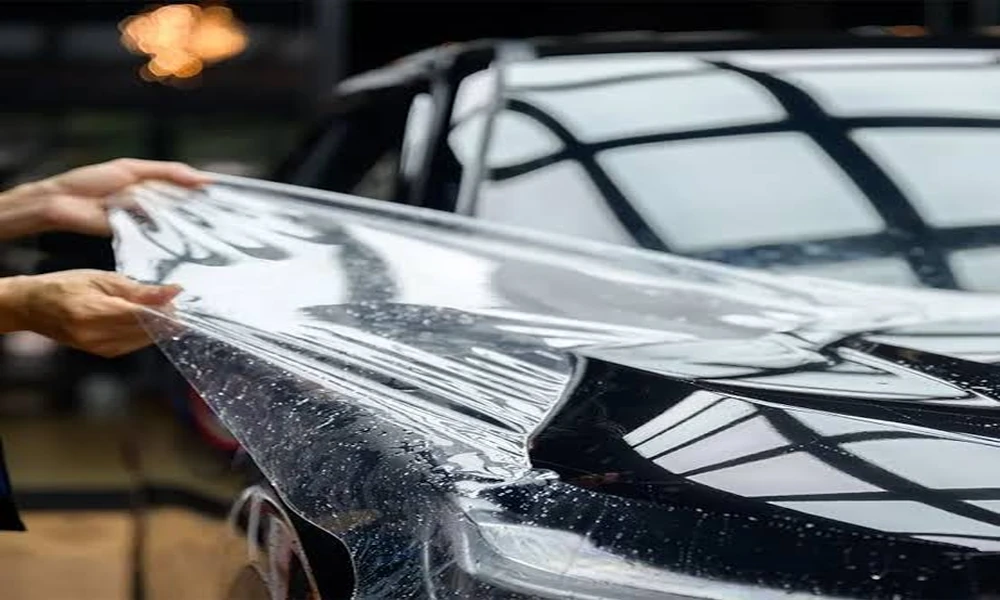
Water beading has become something of a visual shorthand for a well-protected car. Detailing videos linger on it. Product advertisements show slow-motion droplets sliding off a bonnet. It is satisfying to watch, but it is fair to ask whether it is anything more than a nice effect.
The answer is yes, though not always for the reasons people assume. The behaviour of water on a car’s surface affects how quickly it gets dirty, how easily it cleans and how much mineral residue builds up over time. When that behaviour is built into a protective film, it adds practical value to a product that already guards against chips and scratches.
The Science in Plain Terms
Every surface has a property known as surface energy. High-energy surfaces attract water, so it spreads out into a flat film. Low-energy surfaces repel water, so it pulls itself into rounded droplets.
A hydrophobic coating lowers surface energy. Water sitting on it forms tight beads with a high contact angle, meaning the droplet sits up rather than spreading. Those beads move more easily and roll off when the surface is tilted or when the car is moving.
As they roll, they can pick up loose dust and dirt. That is why water-repellent surfaces often look cleaner after rain than untreated ones.
What Makes a TPU Film Hydrophobic
Standard protection films are made from thermoplastic polyurethane and include a top coat. In a tpu hydrophobic paint protection film, that top coat is formulated to repel water as well as resist stains and scratches.
This differs from applying a separate coating on top of ordinary film. The water-repellent property is part of the film’s own surface, so it is present from the day of installation. Whether it lasts as long as the film itself depends on the product and how the car is cared for, which is why it is worth asking about durability when choosing.
The underlying protection remains the same. The TPU base still absorbs impacts from small stones and debris. The top coat still helps light scratches soften with heat in many products. Water repellency is an addition, not a replacement.
Why Beading Matters in Everyday Use
Less dirt sticks
When water carries dust away instead of leaving it behind, less grime accumulates between washes. Cars driven daily often look presentable for longer.
Fewer water spots
Water that sits and evaporates leaves behind minerals, especially in areas with hard tap water or after rain carrying pollutants. These spots can etch into finishes over time. Water that rolls off leaves fewer of them behind.
Faster washing and drying
Soap and dirt rinse away more easily from a water-repellent surface. Drying is quicker too, since there is less water clinging to panels.
Better resistance to staining
Many contaminants, such as bird droppings and tree sap, are harder to bond to a low-energy surface. They still need removing promptly, but they tend to lift more easily.
Where Hydrophobic Film Makes the Biggest Difference
Cars that live outdoors benefit most. Morning dew, rain, pollen and dust all settle on a parked car, and a water-repellent surface sheds much of it.
Drivers in wet or coastal climates see clear benefits too. Road spray, salt mist and frequent rain make it difficult to keep a car clean. A surface that releases water and dirt easily helps.
Busy owners who do not have time for frequent detailing sessions also appreciate the reduced effort. A rinse between full washes often goes further.
Hydrophobic Film Versus Ceramic Coating
Ceramic coatings are well known for their water-beading effect. They are chemical layers bonded to paint, offering gloss, water repellency and some chemical resistance. They do not stop stone chips, because they are far thinner than film.
Hydrophobic film combines physical impact protection with water-repellent behaviour. For owners who want both chip protection and easy cleaning, it can reduce or remove the need for a separate coating on filmed panels.
Some owners still choose to coat the rest of the car, or to add a film-safe coating on top for extra gloss. That decision should be made with the installer, since compatibility matters.
Keeping the Effect Working
Hydrophobic performance can be reduced by contamination and harsh products. Road film, traffic grime and residues from some car wash chemicals can coat the surface and make it behave as though it is less water-repellent.
Regular gentle washing with a pH-neutral shampoo helps keep the surface clean and working. Avoid abrasive polishes and harsh degreasers, which can wear the top coat. If beading appears weaker, a thorough wash often restores it, because the issue is usually a layer of contamination rather than the coating itself.
Some installers recommend periodic maintenance products designed for film. These should be chosen carefully to avoid anything that could interfere with the top coat.
A Note on Expectations
Water repellency is helpful, but it does not make a car self-cleaning. Heavy mud, road tar and baked-on insects still need washing off, and a car parked under trees will still collect sap. What changes is how much effort that cleaning takes and how long the car stays presentable between washes.
It is also worth remembering that beading can look different depending on conditions. On a dusty surface, water may sheet rather than bead until the car has been washed. That is normal and not necessarily a sign that the top coat has worn away.
Questions to Ask Before Choosing
How long is the water-repellent effect expected to last? Is it covered by the warranty? What cleaning products are recommended or prohibited? Does the film have the same clarity and impact protection as the supplier’s standard clear film?
Clear answers to these questions help separate genuinely useful products from ones where water repellency is mostly a marketing line.
More Than a Visual Trick
It is easy to dismiss water beading as something that looks good on video. In reality, it influences how a car ages, how much time its owner spends cleaning it and how well its surface resists everyday contaminants. Built into a protective film, it turns a product designed to guard against damage into one that also makes ownership a little easier, day after day.
