
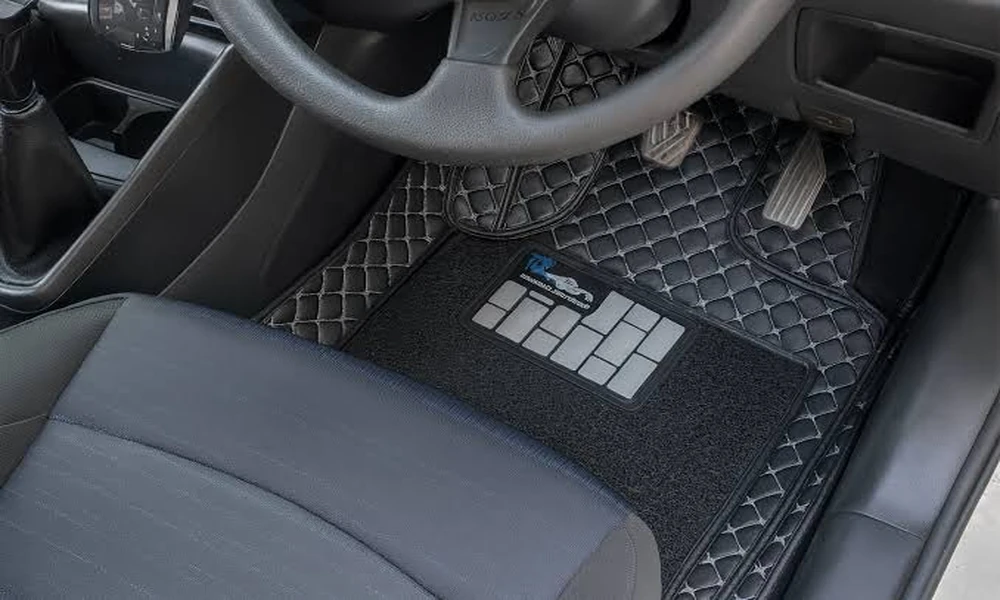
When both carpet and all-weather mats are available after an interior clean, choose the appropriate driver’s mat rather than stacking them. A freshly cleaned carpet mat is not an underlay for another removable mat. Toyota’s floor-mat guidance warns against stacking and calls for proper fit, fastening and pedal clearance. Use the instructions for the actual vehicle before it moves.
A second set is an alternative, not another layer
Seasonal cleaning can bring two sets together. The carpet mats have been taken out, cleaned and made presentable again, while the all-weather set is ready for the next part of the year. It can feel wasteful to put the clean carpet set away immediately. An owner may be tempted to leave it in place and put the other set over it for extra protection.
That treats two alternatives as layers of one system. The fact that both pieces are sold as floor mats does not mean they belong together in the driver’s footwell. Their purpose is not to add as much removable material as possible beneath the driver’s feet. The chosen arrangement must match the vehicle’s actual instructions.
Toyota’s floor-mat safety guidance says mats should not be stacked, should suit the vehicle and should not interfere with the pedals. It also addresses orientation and retention. Follow the manual for your own model and equipment rather than transfer a fastening method from the UK page’s general guidance to a different car.
During a Vaughan car-detailing visit at SRS Tints, identify which removable mats are being cleaned and which set you intend to use afterwards. If both sets are present, make clear that they are alternatives. A request to clean them all should not be interpreted as a request to return them all to the same driver’s footwell.
Choose the supported mat for the actual vehicle
Begin with the identity of the mat, not just whether it looks tidy after cleaning. A piece from another car may appear close in size while having a different shape or retention arrangement. Even an apparently familiar accessory should be checked against the correct model and year. Appearance alone does not settle fit.
Keep any product identification and instructions available when choosing between the sets. An owner may have inherited one with a used vehicle or purchased the second later. If the history is uncertain, ask the appropriate vehicle or accessory support to identify it. Do not assume that years spent in the car establish that the arrangement was correct.
Toyota’s 2021 RAV4 manual section on preparing to drive, for example, specifies mats for the same model and year, the driver’s position and the provided retainers, and prohibits two or more stacked mats. It is a concrete example of why the actual manual matters. Owners of another model should use its instructions.
Inspect the relevant condition before deciding a set is ready. If a retainer is broken or the mat cannot be positioned as instructed, obtain appropriate help. Do not solve the difficulty by laying a second mat over it, fitting an improvised clip or cutting material away until it seems to fit. The uncertainty is a reason to resolve the product or fastening question.
A preference for carpet or all-weather material can remain part of the choice once suitability is established. The owner can decide which supported option fits the season and personal preference. There is no need to preserve both appearances at once by combining them in the driver’s area.
Keep the unused set out of the driver’s footwell
Give the spare set a destination before the interior is reassembled. At home, a suitable storage place can keep it identifiable for a later change. If it must travel in the car temporarily, arrange appropriate secure storage away from the driving controls. Do not leave an extra mat loosely near the driver’s feet because it will be put away after one short journey.
Keep matching pieces together so that a later change does not begin with uncertainty about which driver’s mat belongs to which set. Product information can stay with the stored mats. This makes seasonal swapping a choice between known alternatives rather than a search through a mixed pile of accessories.
Tell another regular driver which set is in use. A person who sees the cleaned carpet mat in storage may otherwise return it to its familiar place without realising the other mat is already fitted. The useful message is simple: this is the current set, and that is the alternative being kept for later.
Do not use a temporary towel, loose carpet offcut or another layer to preserve the newly cleaned appearance in the driver’s footwell. If you are concerned about keeping a mat presentable, seek a care approach consistent with the product and vehicle instructions. Extra loose material should not become an informal substitute for the supported arrangement.
Check the arrangement before the car moves
Review the selected mat while the vehicle is safely parked. Follow the exact manual’s instructions for retention and checking pedal clearance. The cited RAV4 instructions call for a check with the engine stopped and transmission in Park, and emphasise checking after floor cleaning. Use the procedure applicable to your own vehicle rather than making a driving experiment.
If fit or fastening remains uncertain, resolve it with appropriate professional assistance before driving. A quick trip around the block is not a suitable test of whether a mat can interfere with a control. The concern belongs in a stationary inspection using the proper instructions.
Cleanliness can make the chosen arrangement pleasant, but it does not establish that it is correctly fitted. Look at the driver’s area as the working space for the controls, not only as the best-looking part of the freshly detailed floor.
Put the unused carpet driver’s mat into its chosen storage place when the supported all-weather one is in use, or store the all-weather alternative when choosing carpet. The seasonal clean then ends with one appropriate mat secured in the driver’s footwell, rather than two clean products stacked into the wrong arrangement.
