
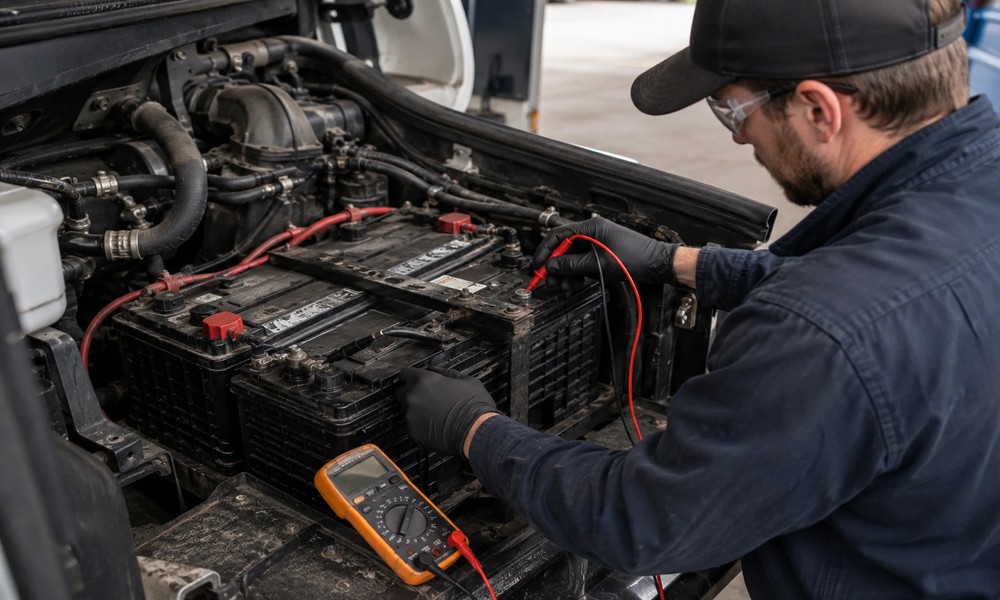
A diesel truck that will not start is not moving, and the most common reason a diesel truck fails to start has nothing to do with the engine, the fuel system, or the injection components. It is the charging system – the batteries, alternator, and the connections between them – that is responsible for the majority of no-start events on commercial and heavy-duty diesel vehicles. Understanding how the diesel charging system works, what distinguishes it from a gasoline vehicle’s charging system, and how to maintain each component is practical knowledge that prevents roadside failures and costly tow bills.
Modern diesel trucks are more electrically demanding than any previous generation. The engine control module, aftertreatment systems, telematics, cab electronics, and auxiliary equipment all draw from the same charging system that must also crank an engine with compression ratios that dwarf anything in a gasoline vehicle. When that system is operating at the margins of its capacity – aging batteries holding less charge than their labels suggest, an alternator producing at the low end of its output range, corroded connections adding resistance throughout the circuit – the next cold morning or long idle period is often what tips a marginal system into failure.
Why Diesel Trucks Use Dual-Battery Systems
Virtually every heavy-duty and most medium-duty diesel truck runs a dual-battery configuration, and the reason is purely the physics of compression ignition. A diesel engine starts by compressing air until it is hot enough to ignite injected fuel – no spark plugs, no ignition coil, just compression heat. Achieving that compression requires cranking the engine at sufficient RPM against compression ratios typically ranging from 16:1 to 23:1. The electrical current required to spin a starter motor against that resistance is substantial: diesel starters routinely draw 800 to 1,500 amperes during cranking, compared to 150 to 400 amperes for a typical gasoline engine starter.
A single battery capable of delivering that cranking current reliably across temperature ranges and the full span of its service life would need to be physically enormous. Two batteries wired in parallel – the standard diesel configuration – doubles the available cranking amperage and total reserve capacity while using batteries of manageable size and weight. The practical consequence is that a diesel truck’s charging system is managing twice the battery capacity of a comparable gasoline vehicle and must keep both batteries charged and balanced simultaneously.
The dual-battery setup introduces a maintenance complexity that single-battery vehicles do not face: battery imbalance. When one battery in a parallel pair begins declining in capacity – which happens gradually and invisibly as batteries age – the stronger battery carries more of the load during cranking and more of the charging current during operation. The weaker battery free-rides on the stronger one, continuing to measure acceptable voltage while delivering far less cranking current than its label implies. The result is that a dual-battery system can test within acceptable voltage parameters and still fail to crank a cold engine in winter conditions, because the aggregate cranking capacity of the mismatched pair is insufficient even though neither battery individually reads as failed.
Battery Selection and Specifications – What the Numbers Mean for Diesels
Diesel truck batteries are specified by two primary ratings: Cold Cranking Amperes (CCA) and Reserve Capacity (RC). CCA measures the amperage a battery can deliver for 30 seconds at 0°F while maintaining at least 7.2 volts – it is the number most directly relevant to cold-weather starting performance. Reserve Capacity measures how many minutes a fully charged battery can sustain a 25-ampere draw while remaining above 10.5 volts – it determines how long the truck can operate on battery power alone if the alternator fails.
For heavy-duty diesel applications, batteries are typically specified at 800 CCA minimum per battery, with many Class 8 applications using 950 to 1,050 CCA units. Matching both batteries in the pair to identical CCA ratings from the same manufacturer and ideally from the same production batch is the best practice for minimizing the imbalance problem described above. Mixing batteries of different ages, brands, or CCA ratings in a parallel pair accelerates deterioration of both units and reduces the effective cranking capacity of the combined system below what either battery’s individual rating would suggest.
Battery chemistry matters for severe-duty applications. Absorbed Glass Mat (AGM) batteries offer substantial advantages over conventional flooded lead-acid batteries in diesel truck service: superior vibration resistance, higher cycle durability, faster recharge acceptance, and better performance at temperature extremes. AGM batteries tolerate the deep discharge cycles that occur when trucks are parked for extended periods running cab electronics and climate systems, then recovered by alternator charging – a cycle that degrades flooded batteries rapidly. The higher purchase cost of AGM batteries is typically recovered in extended service life and reduced replacement frequency.
The Alternator – Output Requirements and Failure Modes
The alternator converts engine mechanical power into electrical current to charge the batteries and supply all on-board electrical loads while the engine runs. Diesel truck alternators are typically rated at 130 to 200 amperes output for pickup-class trucks, and 160 to 270 amperes for commercial Class 6-8 applications. That output must cover the combined electrical demand of all on-board systems – charging the battery bank, powering the ECM, running the aftertreatment systems, supplying cab heating and air conditioning, operating exterior lighting, and powering any auxiliary equipment – simultaneously, with enough margin remaining to actually charge the batteries when they have been partially discharged.
Alternator output is not constant across engine speeds. Most heavy-duty alternators reach their rated output at engine speeds of 1,800 to 2,500 RPM. At low idle – 600 to 800 RPM on most diesel engines – output may fall to 50 to 70 percent of rated capacity. A truck idling for extended periods running a full electrical load – climate control, lighting, telematics, cab electronics – may actually consume battery reserve faster than the alternator can replenish it at idle speed. This is why extended idling gradually depletes battery charge even with a functioning alternator, and why batteries that appear healthy during normal operation can struggle to crank a cold engine after an overnight idle.
Alternator failure is typically gradual rather than sudden. The most common failure sequence begins with diode degradation inside the rectifier assembly, which reduces total output amperage without fully eliminating it. The alternator continues producing voltage within the normal range but at reduced current capacity. Battery charge gradually declines between operating sessions. Voltage at the battery terminals while the engine runs at normal RPM falls slightly below the 13.5 to 14.5 volt range that indicates proper charging. Without a calibrated voltmeter or battery monitoring system, this decline is invisible until the batteries can no longer crank the engine.
Bearing wear and rotor or stator winding degradation are the other common alternator failure paths, and both typically produce audible warning before complete failure: a growling or whining noise from the alternator that increases with engine speed, or intermittent electrical flickers as the rotor’s contact with brushes becomes inconsistent. Catching these symptoms during routine service inspections allows alternator replacement on a scheduled basis rather than as an emergency roadside repair.
Connection Integrity – The Overlooked Charging System Variable
The batteries and alternator receive most of the attention in charging system maintenance, but the connections between them are responsible for a disproportionate share of charging system problems. Every resistance point in the charging circuit – corroded battery terminals, loose cable connections at the alternator output post, degraded ground straps between the engine block and chassis, oxidized junction blocks in the cable routing – reduces the current that reaches where it is needed and generates heat that accelerates further corrosion and connection degradation.
The ground circuit deserves particular attention. The charging system relies on complete circuit continuity: current flows from the alternator positive terminal, through the battery, and returns to the alternator and engine via the ground path. The primary ground connection – from the negative battery terminal to the engine block and chassis – carries every ampere that the starter draws during cranking and every ampere the alternator produces during charging. A corroded or loose ground connection that adds resistance to this path reduces cranking power and charging efficiency simultaneously, producing symptoms that mimic both a weak battery and a failing alternator.
Battery terminal inspection and cleaning should be part of every preventive maintenance interval. White or bluish-grey corrosion at the terminals is lead sulfate and copper oxide byproduct of normal battery chemistry – its presence is not a sign of battery failure, but its accumulation is a sign that cleaning is overdue. Clean terminals with a wire brush and appropriate terminal cleaner, dry thoroughly, reconnect securely, and apply a corrosion-inhibiting coating to slow future accumulation. Inspect all cable ends at both ends of every cable in the charging circuit, not just at the battery terminals.
Diagnostic Approach – Testing the Charging System Systematically
A systematic approach to charging system diagnosis prevents the common mistake of replacing a battery that is failing due to an alternator problem, or replacing an alternator that is underperforming due to connection resistance. The diagnostic sequence begins with the simplest measurements and progresses to more specific testing only when the simpler tests do not identify the problem. This same structured, sequential approach applies across all diesel systems: diesel engine diagnostics and fault code troubleshooting consistently outperforms reactive parts replacement in both diagnostic accuracy and total repair cost.
Static battery voltage – measured with the engine off and no loads connected, after the truck has sat for at least two hours – establishes a baseline battery state of charge. A fully charged 12-volt battery reads 12.6 to 12.8 volts. Below 12.4 volts indicates partial discharge; below 12.0 volts indicates significant discharge or capacity loss. In a dual-battery system, measure each battery individually: a significant voltage difference between the two batteries (more than 0.2 volts at rest) indicates imbalance that warrants load testing both batteries separately.
Charging voltage – measured at the battery terminals with the engine running at 1,500 to 2,000 RPM and no major electrical loads active – should read 13.5 to 14.5 volts. Below 13.5 volts indicates insufficient alternator output or excessive resistance in the charging circuit. Above 14.8 volts indicates a voltage regulator problem that is overcharging the batteries. Measure at the alternator output terminal as well as at the battery: if alternator output voltage is within range but battery terminal voltage is lower, the difference represents resistance loss in the charging cable between them.
Load testing both batteries individually under controlled current draw – using a dedicated battery load tester – is the definitive test of remaining battery capacity. A battery that reads 12.7 volts at rest but drops below 9.6 volts under load has insufficient cranking capacity even though its resting voltage appeared normal. This is the test that identifies the battery imbalance problem in dual-battery systems that static voltage measurement misses.
Maintenance Intervals and Integration with Scheduled Service
Charging system maintenance is most effective when integrated into the scheduled service intervals that govern all other diesel truck maintenance rather than performed reactively when problems appear. Heavy-duty truck preventive maintenance schedules structured around mileage and time intervals provide natural inspection points for charging system condition checks that catch developing problems before they produce failures.
At every oil change interval, inspect all battery terminal connections and cable ends for corrosion, check battery case condition for cracks or swelling, and verify battery hold-down security. A loose battery that vibrates in service fails faster and can cause cable damage from chafing. Check alternator belt condition and tension – a slipping belt reduces alternator output and produces belt wear that can lead to sudden belt failure.
Annually or at 50,000-mile intervals for high-mileage commercial trucks, load-test both batteries individually and record the results. Trending battery capacity over successive annual tests identifies declining batteries before they reach the threshold of unreliability. Replace batteries in pairs when either one in a parallel set falls below acceptable capacity – installing one new battery alongside a partially degraded battery recreates the imbalance problem within months.
The specific replacement intervals:
- Conventional flooded batteries in diesel truck service: 3 to 4 years average service life under normal conditions, shorter with frequent deep cycling or extreme temperature exposure
- AGM batteries: 4 to 6 years average service life, with better retention of capacity through more of their service life
- Alternators: 150,000 to 200,000 miles in normal commercial service, with bearing inspection recommended at 100,000-mile intervals
- Charging cables and grounds: inspect annually, replace any cable showing cracking insulation, green corrosion at connection points, or evidence of heat damage
The Bottom Line
The diesel truck charging system is the enabler of everything else. No matter how well-maintained the engine, fuel system, and drivetrain are, a failed charging system stops the truck as effectively as any mechanical failure – and does so at the least convenient moments, because cold temperatures and extended idling are exactly the conditions that reveal the margins that adequate maintenance would have preserved.
Dual-battery management, alternator output monitoring, connection integrity inspection, and systematic load testing are not complex procedures, but they require deliberate attention at regular intervals rather than reactive response to symptoms. Building charging system checks into the scheduled maintenance cadence for a diesel truck converts what is often an emergency repair into a routine parts replacement on a timeline that works for the operator rather than against them.
